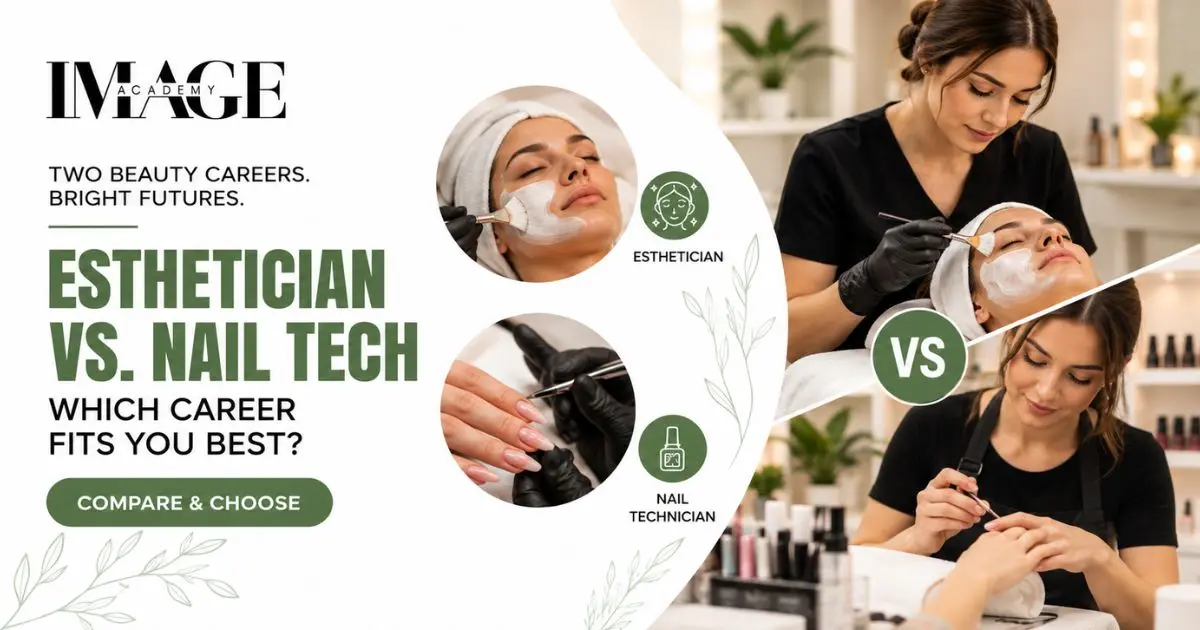

If you love skincare, facials, and helping people feel confident in their own skin, esthetics is likely your path. If you love nail art, color, and detailed hands on work, nail technology is probably the better fit. Both careers are in high demand, both can be finished in under a year, and both let you start earning money fast.
This guide breaks down the real differences between an esthetician and a nail technician, including training time, pay, and what your day-to-day work actually looks like, so you can choose the path that matches your interests and goals. Whichever path you pick, you will graduate with a real license and a real skill you can use anywhere in Texas.
Both careers are in strong demand across the Houston area. Skin care has grown fast thanks to the rise of medical spas, which need estheticians for facials, peels, and pre and post treatment skin care. Nail care has grown just as fast, since manicures and pedicures have become a routine part of most people’s beauty budget, not an occasional treat.
Because both fields are growing, the better question is not which career has more jobs. It is which day-to-day work you would enjoy more, since you will be doing that work for years to come.
Estheticians are skin care specialists. They perform facials, chemical peels, waxing, extractions, and skin consultations to help clients improve and maintain healthy skin. Many estheticians also apply makeup or offer add-on treatments like microdermabrasion or lash and brow tinting.
Estheticians usually work in day spas, medical spas, or salons, and the job involves a lot of one-on-one time with each client. If you enjoy science, skin health, and building long-term relationships with regular clients, this path tends to feel like a natural fit.
As estheticians gain experience, many move into specialized areas like medical esthetics, where they support dermatologists or plastic surgeons with pre and post procedure skin care. Others stay in day spas and build a loyal following around relaxing, results-driven facials.
Learn more about the day-to-day work in our guide on what does an esthetician do, or explore our full esthetician program.
Nail technicians specialize in nail care and nail art. They perform manicures, pedicures, and artificial nail applications like acrylics, gels, and dip powder, and many also create detailed nail designs for clients who want something custom.
Nail technicians usually work in nail salons, full-service salons, or private suites. The work is detail-oriented and creative, and it rewards technicians who enjoy precision, steady hands, and staying current on nail trends and techniques.
As nail technicians gain experience, many specialize in areas like nail art, competition sets, or long-lasting enhancements, which can command higher prices than a standard manicure. Others build a large social media following around their designs, which becomes its own client-generating tool.
New to the field? Check out our guide on what beginners need to know about becoming a nail technician, or explore our full nail tech program.
In Texas, an esthetician license requires 750 clock hours of training at a school licensed by TDLR, the Texas Department of Licensing and Regulation. A nail technician license, which Texas calls a manicurist license, requires 600 clock hours. Because nail technology requires fewer hours, many students finish nail tech training a bit faster than esthetics, depending on their schedule.
Both programs cover state law, sanitation, and hands on client work, and both lead to a licensing exam through TDLR before you can legally work in Texas. If you want the full hour by hour breakdown, our guides on how long it takes to become an esthetician and nail tech license requirements in Texas walk through the timeline for each path.
Both programs also include supervised hands on training in a school clinic, where students practice real services on real clients before graduation. This clinic time is where most students build the speed and confidence they need to walk into their first job feeling prepared, not just book-smart.
Program cost varies by school and by how many clock hours a license requires, so an esthetics program, which requires more hours, is often priced a bit higher than a nail tech program. The good news is both careers cost far less and take far less time than a traditional four year degree, and financial aid options are often available for students who qualify.
If tuition is a big factor in your decision, our guide on how to pay for beauty school in Texas breaks down financing options step by step, so you know what to expect before you enroll.
Estheticians in Houston typically earn between $35,000 and $57,000 a year, or about $19 to $28 an hour. Nail technicians in Houston typically earn between $32,000 and $50,000 a year, or about $16 to $23 an hour. Both figures can grow quickly once you build a loyal client base, since tips and commission make up a real part of your paycheck in either career.
Nail technicians often see clients return every two to three weeks, while esthetician visits are usually spaced four to six weeks apart. That means nail techs may book more total visits per client each year, while estheticians often charge more per visit for longer, more involved services. Both paths can lead to strong income once you build a steady schedule.
In both careers, tips and commission usually make up a real part of your take-home pay, not just a nice bonus. A busy esthetician or nail technician who rebooks clients consistently can often out-earn someone in either field who is less consistent about filling their schedule.
An esthetician’s day is usually built around longer appointments. A single facial or peel can take 45 minutes to an hour, so a full day might include six to eight clients, each one getting focused, hands on attention along with a skin consultation.
A nail technician’s day usually moves at a faster pace. Manicures and pedicures often take 30 to 60 minutes, so a full day can include eight to twelve clients, especially during busy weekends. If you like variety and a quicker pace, that rhythm might appeal to you more than longer, slower sessions.
| Esthetician | Nail Technician | |
|---|---|---|
| Focus | Skin care and facial treatments | Nail care, art, and enhancements |
| Texas training hours | 750 clock hours | 600 clock hours |
| Typical program length | About 6 to 9 months | About 4 to 6 months |
| Typical annual pay in Houston | $35,000 to $57,000 | $32,000 to $50,000 |
| Where you work | Spas, med spas, salons | Salons, nail studios, private suites |
| Repeat client cycle | Every 4 to 6 weeks | Every 2 to 3 weeks |
| Hands-on style | Facial massage, extractions, waxing | Filing, polish, acrylics, nail art |
Still not sure which path is right for you? Think about what kind of work makes you lose track of time, and let that guide your decision more than the paycheck alone. Both careers can support you well once you build a client base, so pick the one you will actually enjoy doing every single day.
Success in either career comes down to more than just technical skill. Estheticians tend to thrive when they are patient, good listeners, and genuinely curious about skin health, since clients often share personal concerns about their appearance during a facial. A calm, reassuring presence goes a long way in this line of work.
Nail technicians tend to thrive when they have steady hands, an eye for detail, and a creative streak, since clients increasingly want custom nail art rather than a plain polish. Speed matters too, since a full schedule of clients depends on working efficiently without rushing the quality of the service.
Both careers reward strong communication skills, since a big part of the job is understanding exactly what a client wants before you start, then recommending the right service or product to help them get there.
Yes. Some students choose to train in both skin care and nail care to widen the services they can offer clients and increase their income potential. Texas even offers a combined license path for students who want to be licensed in both specialties. If you like the idea of offering both, check out our combined esthetician and nail tech program to see how the training works together.
Neither program is harder than the other, but esthetics does require more training hours in Texas, at 750 hours compared to 600 hours for nail technology, so it usually takes a bit longer to complete.
Estheticians in Houston typically earn slightly more on average than nail technicians, though both careers can reach similar income once you build a strong client base and add specialty services.
Yes. You can train in both specialties, either through separate licenses or a combined license path, which lets you offer both skin care and nail services to the same clients.
Nail technology requires 600 clock hours in Texas, which many students complete in about four to six months depending on their schedule.
No. An esthetician license is a separate specialty license focused only on skin care, and it does not require a full cosmetology license to practice.
Both careers can lead to self-employment, but nail technicians and lash technicians often go independent sooner because their services require less equipment and lower overhead than a full skin care studio.
No. Many beauty professionals start in one specialty and add another later, or switch paths entirely once they know the industry better. Your first license is a starting point, not a lifetime commitment.
Both esthetics and nail technology offer a fast, hands on route into a beauty career with strong earning potential. The best choice comes down to what kind of work excites you the most. Image Academy in Houston offers hands on training in both esthetics and nail technology, so you can explore each path before you commit. Schedule a tour or browse our full list of programs to take the next step.