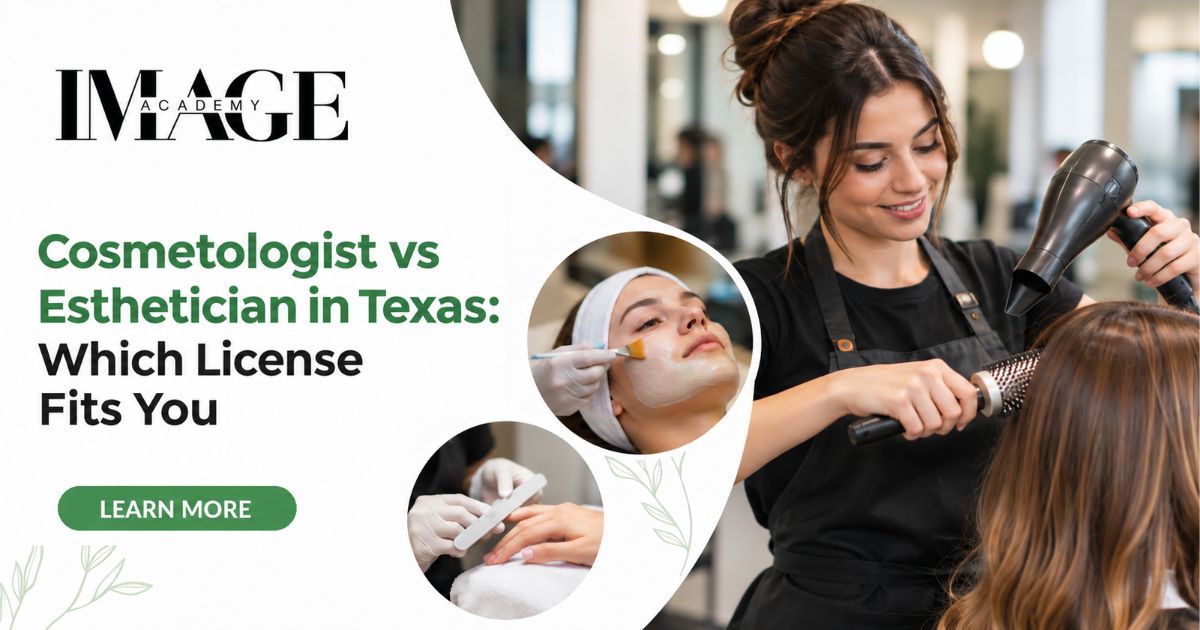
A cosmetologist can work on hair, skin, nails, and lashes. An esthetician focuses on skin care, lashes, and hair removal, and cannot do hair or nails. In Texas, a cosmetology license takes 1,000 training hours. An esthetician license takes 750 hours. Pick the one that matches the work you want to do every day.
Are you stuck between two beauty careers? You are not alone. Many future students ask the same thing. Both jobs are creative. Both help people feel good. Yet they are not the same, and the choice changes your training, your daily work, and your license.
This guide uses the Texas Department of Licensing and Regulation, also called TDLR, as its main source. TDLR writes the rules for every beauty license in the state. We will keep the words simple and the facts clear. By the end, you will know which path fits you best.
Think of it this way. A cosmetologist is a wide-angle lens. An esthetician is a zoom lens.
A cosmetologist learns many skills. That includes hair, skin, nails, and more. An esthetician learns one area deeply. That area is skin care.
Here is the side-by-side view for Texas.
Cosmetology operator
Esthetician
This list comes from the TDLR scope of practice pages. Scope of practice simply means the list of services the law lets you do for pay.
A licensed cosmetology operator has the biggest list of services. TDLR says an operator may do all of these for pay:
There is one limit. A cosmetologist may not shave with a straight razor. The license allows a safety razor only.
This wide list is why many people choose cosmetology. You can work in a hair salon, a nail bar, or a spa. You can also change your focus later without a new license. Ready to see what the training looks like? Visit our cosmetology program page.
An esthetician has a smaller list, but it goes deep. TDLR says an esthetician may do these services for pay:
An esthetician may not do any of these:
What about peels and makeup? The TDLR page does not list them by name. So ask TDLR before you offer a service that is not clearly on the list.
Skin care rewards people who love detail. Learn more on our esthetician program page.
Texas sets the minimum hours for each license.
The gap is 250 hours. At 30 hours a week, that is about eight extra weeks. So the cosmetology path takes a bit longer. Your own schedule makes the final answer. Our guide on how long cosmetology school takes in Texas explains how full-time and part-time plans compare.
There is also a middle path. Texas has a combined license for people who want nails and skin care. It is called manicurist and esthetician. You can take an 800-hour combined course. Or you can take a 750-hour esthetician course plus a 600-hour manicurist course. If that sounds like you, read esthetician vs nail technician for a clear comparison.
The steps look almost the same for both careers. Here is what you share:
The exams are run by a testing company called PSI. For the cosmetology exam steps, read our Texas cosmetology exam guide. For the esthetician path, see how to become an esthetician in Texas.
Before you enroll in either one, check what schools ask for. Our guide to beauty school requirements in Texas covers age, education, and the student permit.
The license is only part of the story. The daily work feels very different.
A cosmetologist’s day moves fast and changes often. You may cut hair in the morning. After lunch, you might do a color service. You talk to many clients, and you often build a loyal group of regulars. The work is active and social.
An esthetician’s day is calmer and more focused. You work in a quiet treatment room. You study a client’s skin, pick products, and plan a series of visits. You often see the same clients over many months and watch their skin improve. The work is gentle and detail driven.
Neither day is better. They simply suit different people.
Take a minute with each question. Be honest.
If most of your answers point one way, you have your answer.
Lashes are popular, and both licenses allow eyelash extensions. That surprises many students. You do not need a cosmetology license just to do lashes.
If lashes are your main goal, there is a third path. Our lash tech program is built for that goal. To see how it compares with the full cosmetology path, read lash tech vs cosmetology.
Nails are part of cosmetology, but an esthetician cannot do them. If nails are your passion, you have two good options. You can take the full cosmetology path. Or you can take a focused nail program. See our nail tech program and our guide to nail tech license requirements in Texas.
Some ideas about these jobs are simply wrong. Let us clear up four of them.
Myth 1: A cosmetologist is the same as an esthetician. They are not the same. The licenses cover different services, and the hours are different too.
Myth 2: An esthetician can do hair. In Texas, no. TDLR does not allow any hair service on an esthetician license.
Myth 3: You need a cosmetology license to do lashes. You do not. Both an esthetician and a cosmetologist can apply eyelash extensions.
Myth 4: Cosmetology is always the better choice because it covers more. More services mean more training time. If you only want skin care, the shorter path may fit you better.
No matter which license you pick, the school matters. A good program helps you feel ready on day one of your career. Look for these signs:
You can learn about our school and our team on the About Us page. Knowing the people who will teach you is a big part of the decision.
Pay and cost matter, but they depend on many things. Your skills, your location, and your client list all change the numbers. We keep that detail in its own guides so you get the full story.
A smart way to decide is to look at both lists together. Pick the path that fits your goals and your budget.
Meet Maria. She loves bright hair color and enjoys talking with many people. She wants a busy chair and a full calendar. Cosmetology fits her well.
Now meet Sam. He loves skin science and likes quiet, one-on-one work. He wants to start earning sooner. Esthetics fits him well.
Both made a smart choice. They simply matched the license to their own style.
Still not sure? Try this quick rule.
You can also ask a school how your hours would count if you add a second license later. Rules can change, so ask about it before you enroll.
No. TDLR does not let an esthetician do any hair service. That includes cutting, coloring, and styling. You need a cosmetology license for hair work.
Yes. A cosmetology operator can give facials and other skin treatments. An esthetician simply goes deeper into skin care in school.
Yes. Texas requires 750 hours for an esthetician and 1,000 hours for a cosmetology operator. The time you spend depends on your schedule.
Yes. TDLR lists eyelash extensions on the esthetician list. A cosmetologist can do them too.
Body hair removal is on the esthetician list. Waxing is a common way to do it, but the TDLR page does not name waxing. If you are unsure, ask TDLR before you offer the service.
Neither one is better for everyone. Cosmetology is broader. Esthetics is more focused. The best license is the one that matches your goals.
Yes. Some people earn both licenses over time. Ask your school how hours count before you plan it.
You now know the real differences. The next step is to see it in person.
Image Academy teaches cosmetology, esthetics, nail tech, and lash tech in Houston. See all of them on our courses page. Then book a campus tour or call us at (281) 692-4892. We are at 14520 Memorial Dr #45, Houston, TX 77079.
Bring your questions. We will help you choose the license that fits your life.